
ASCII Chart
ASCII Table - Standard and Extended ASCII Chart, ASCII Codes
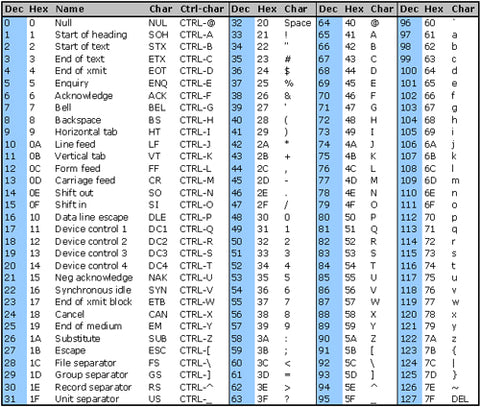
ASCII stands for American Standard Code for Information Interchange. It ranges from 0 to 255 in Decimal or 00 to FF in Hexadecimal. ASCII codes can be divided into two sets - Standard ASCII codes and Extended ASCII codes. Standard ASCII codes range from 0 to 127 in Decimal or 00 to 7F in Hexadecimal, they are mainly used for representing characters, such as characters "a" to "z" and number "0" to "9", these are called printable characters, note that code 0 to 31 (Decimal) in Standard ASCII are not printable, they are assigned for control characters that are used to control some peripheral devices such as printers, for example, 12 represents the Form Feed / New Page function. This command instructs a printer to skip to the top of the next page. The Standard ASCII chart below illustrates the details of the codes. Extended ASCII codes range from 128 to 255 in Decimal or 80 to FF in Hexadecimal. They meet the demand for more characters and symbols that are used for many languages. Together with the control codes (0 to 31) in Standard ASCII table, Extended ASCII codes are also widely used in communication protocol, such as RS-232, RS-485, RS-422 and TTL systems. The Extended ASCII chart below illustrates the details of the codes.
Standard ASCII Chart / ASCII Table - Hex to Decimal Code Conversion
Extended ASCII Chart / ASCII Table - Hex to Decimal Code Conversion
