
Building a Reliable RS485 / RS422 Network
An RS485 / RS422 network consists of many different components, such as cables, RS232 / RS485 / RS422 devices (master and slaves), converters, and power supplies, and because this type of network is normally used over a long distance and in an electrically noisy environment, noises, reflections, and data errors might occur. Building a reliable RS485 / RS422 network by choosing the correct cables, designs, and converters could save a lot of valuable engineering time and make the system free of the above-mentioned problems.
RS485 / RS422 Topology
RS485 / RS422 is a network in a linear, multi-drop configuration; however, star-wiring is inevitable in some places. Our RS485 Hub / Splitter (Model: HUB-485-4) splits an RS485 network into four, thus making star-wiring possible.
RS485 / RS422 Distance
A single RS485 / RS422 loop can go up to 4000ft (1200m) by using standard copper wire (screened twisted pair). This distance (using copper wire) can be extended to another 4000ft (1200m) by using our RS485 / RS422 repeater (Model: RPT-485_422-2 and RPT-485_422-4). Note: A maximum of two repeaters can be used in series. The RS485 / RS422 distance can be further extended to up to 24.8 miles (40km) by using Single-Mode Fiber Optic Cables and our Single-Mode RS232 / 485 / 422 to Fiber Optic Media converter (Model: FBR-Serial-2).
RS485 / RS422 Cabling and Termination
Screened twisted-pair cable (e.g. CAT-5e) is recommended to prevent external noises induced to the RS485 / RS422 buses. Transmission lines are usually terminated to reduce noises and reflections that can cause data errors. Both ends of the bus should be terminated (not each node). See illustration below.

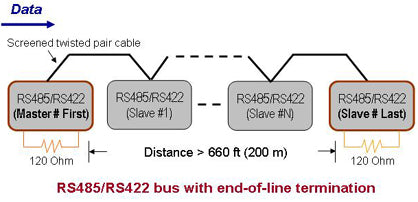
Notes:
- Termination is important for impedance matching and noise / reflection reduction, therefore, it is required regardless of whether port- or externally-powered converters are used.
- Terminator adds heavy DC loading to a system, and therefore, connect it only when the data rate is over 19.2kbps or the RS485 / RS422's distance exceeds 660ft (200m). 3) CommFront's built-in 120-Ohm terminators can be easily turned ON or OFF through a simple jumper setting, thus making our converters ideal solutions for all types of installations.
RS232 / RS485 / RS422 Converters
1. Industrial- or Commercial-grade?
Just as there are many differences between industrial- and commercial-grade computers, the industrial- and commercial-grade converters differ in many ways, such as the level of circuit protection, temperature range and noise tolerance. Most importantly, true industrial-grade converters require rugged components and reliability-engineering designs to withstand heat, vibration, shock and other environmental factors, therefore, they are much more durable than commercial-grade converters. Industrial-grade converters are designed to interface with mission-critical equipment, such as computers, PLC, SCADA and HMI - whether in the field, server room, factory, control room, or fire command center.
2. Port- or Externally-powered?
Most of the RS232 ports come with a +/-3V DC to +/-15V DC port power, and that's the reason why port-powered converters are very popular on the market. However, because the port-powered converters require a minimum of +/-5VDC from the RS232 port, there may be insufficient port power, which could cause data errors. Some of our port-powered converters accept external 5VDC input, which solves this problem effectively. And in case there is no port power at all from the RS232 port, the externally-powered converter (Model: CVT-485_422-4) can be used.
3. Non-isolated or Opto-isolated?
Opto-isolation uses light instead of electrical signals to transmit data. It isolates the RS232 and RS485 devices from each other, thereby effectively protecting RS232 devices from electrical spikes or surges induced by RS485 networks. Furthermore, it reduces noise and eliminates the ground loop problem. If your RS232 or RS485 / RS422 devices are generating a lot of noise, try the opto-isolated converters, which solve the problem most of the time.